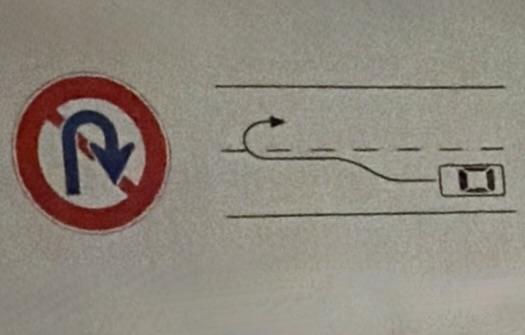
Even when proceeding on a one-way street, vehicles may not drive on the right hand side of the road.
T
F
2
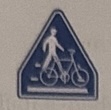
A trafic sign as shown in the figure designates either a pedestrian crossing or bycycle crossing.
T
F
3
Overtakig general mopeds is permited, even where overtaking other vehicles is prohibited
T
F
4
It is important for drivers not to be selfish, but to have a give-and-take spirit, to consider others, and respect pedestrian and/or other drivers.
T
F
5
When vehicular lanes are designated by a yelly line, vehicle must not croee the line, even when making a left or right turning.
T
F
6
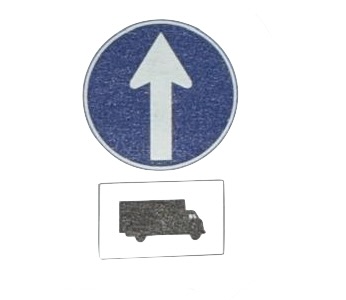
A traffic sign as shown in the figure designates a round that is closed to regular passenger vehicles, larg-size motercycles and ragular motercycles only.
T
F
7
Driver mustt not to overtake when it will not be possible to re-enter the left-hand lane without obstructing the progress of the vehicle ahead.
T
F
8
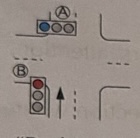
In the situation shown in the figure, when traffic signal Ⓐ at the intersecton, vehicle priceeding in the direction indicated by the arrow may exicute a left turn even if traffic xsignal Ⓑ is red.
T
F
9
"Braking Distance" means the distance from the point at which the driver detect denger to the point at which the driver depresses the brake padel and the brakes start tp operate.
T
F
10
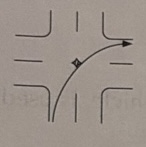
The arrow shown in the figure indicates the correct way to exicute a right turn.
T
F
11
When a vehicle may be forced to stop in an intersection due to congestation and may obstruct the flow of cross traffic, the vehicle must not enter the intersection, even if the signal is green.
T
F
12
Automobiles and general mopeds may proceed on the site strip when the road is congested.
T
F
13
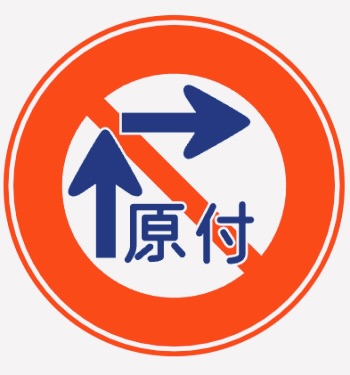
When exicuting a right turn at an intersection when a traffin sign as shown in the figure is dispalyed, general moped must initially approach from as close to the center of the road as possible (excluding one-way streets) and exicute a right turn immidiatly inside the center point of the direction.
T
F
14
Overtaking or passingautomobiles or general mopeds is prohibited at padestian crossing or bycycle crossings or within 30 meters before one.
T
F
15
The term "whelbase differential" refers to the differential that is generated by rear wheels following a path outside the front sheels' turning arc when a vehicle exicutes a turn.
T
F
16
In correct driving posture, the knees are slightly bent when depressing the clutch pedal and the elbow are slightly bent when holding steering wheel.
T
F
17
When a driver passes people with white or yellow cane, unattandend children, senior citizons or others with difficultly
walking, he or she may continue to proceed whike warning these people by sounding the vehicle's horn.
T
F
18
Before changing lanes, drivers must signal after checking the rear view mirror to ensure safety to the rear.
T
F
19
When a vehicles is driven on a learner's permit for practice, a "lerner driver" sign must be displayed in the designated
position on either the front or rear of the vehicle.
T
F
20
Overtaking is prohibited at a railway crossing or within 30 meters before one.
T
F
21
When there are padestrians or cyclist aheead, driver must be prepared to turn the steering wheel to avoid colliding with them in case they behave in an unexpeted manner.
T
F
22
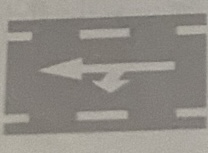
Vehicle may exicute a left turn from a vehicular lane when there is a prevent marking as showen in the figure.
T
F
23
It is advisible for automobile to proceed at the maximum speed limit in order to make traffic flow smoothly.
T
F
24
The designated maximum speed on general raod is 60km/h for automobiles and 30km/h for general mopeds.
T
F
25
If there is a person crossing a padestrian crossing, and he or she stop when a vehicle approaches,
the vehicle may continue to proceed as before.
T
F
26
On a road where the roadway and sidewalks are seperated, vehicle must, in the principle, proceed on the roadway.
However, vehicle may proceed on sidewalks when enteringor livingroadside locations.
T
F
27
A driver must start the vehicle immidiatly after a traffic signal turns green signal designated
"must proceed".
T
F
28
A driver may proceed while decelerating the vehicle's speed from 50km/h tp 20km/h
on a road where a traffic sign as shown in the figure is displayed.
T
F
29
If an emergency vehicle is approaching a location that is not an intersection
or near an intersection, vehicle proceeding of injuries that location must move to the left side
of the road and com to a stop in order to give way to the emergency.
T
F
30
A driver must wear a seatbelt and make sure that passenger wear one too, because seatbelt
can substaintially reduce the risk of injuries in the event of traffic accident.
T
>F
31
Vehicles must proceed verry carefully on raods where traffic signs shown in the figure is displayed,
because there is danger of strong side winds that make steering difficult.
T
F
32
Using a mobile or looking at the screen of car navigation system while driving does not
affect a drivers' attention, and may not result in overlooking possible danger or an accident.
T
F
33
Regular moter vehicle csn proceed straight through, and execute a left or right turn at
an intersection where a traffic sign as shown in the figure is displayed.
T
F
34
When a traffic signal for cross traffic turn red an intersection, the traffic ahead is always green.
T
F
35
A hand signal as shown in the figure, with the extented diagonally downward from the vehicle,
is use to indicate that the vehicle is reversing.
T
F
36
When begining to overtake a vehicle aheas, in order to finifh within a short distance,
move as possible as to the vehicle and then change lane.
T
F
37
When overtaking, a vehicle should pass on the right side of the vehicle ahead, unless
the vehicle ahead is in the center of the road in order to make right turn.
T
F
39
A sign shown in the figure indicate thet is prohibited in the direction of the arrow.
T
F
40
Even ifa vehicle attempting to exicutre a right turn has entered the intersection first,
they must not obstract the progress of oncoming traffic proceeding through, and/or vehicle making left turn. (Except roundboard)
T
F
41
At a railway crossing without traffic signals, drver must bring the vehicle to a complate stop,
open window, and perform a visual and aural check to ensure safety.
T
F
42
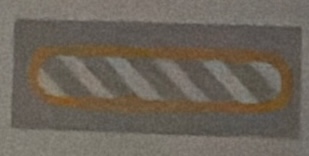
A pavement marking as shown in thw figure designated a "no stopping zone".
T
F
43
Those who do not hold driver's license must not drive automobile or general moped on the raod, even for a very short distance.
T
F
44
A driver must start signaling about three second before intending to change lanes while
the same direction.
T
F
45
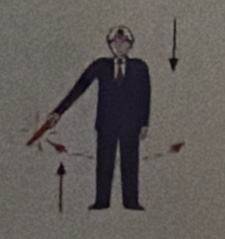
A lamp being moved side-to-side by a police officer as shown in the figure has the same meaning as
the red light of a traffic signal for traffic proceeding in the direction of the arrow.
T
F
46
It is not necessory for a driver to signal when slowingdown orcoming to stop, because there are no way to signal these movements.
T
F
47
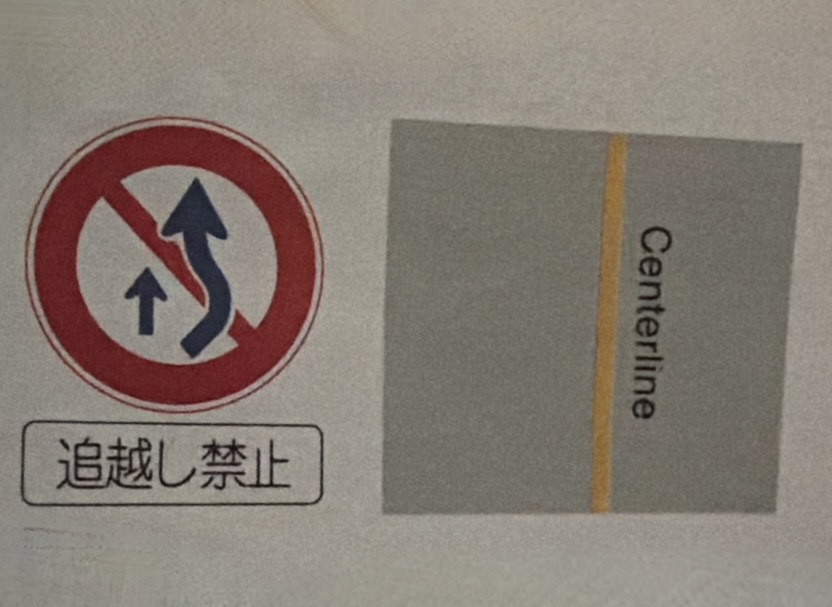
The traffic sign and pevement marking shown in the figure have the same meaning.
T
F
48
When passing a padestrian a driver must leave a safe, wide berth between the vehicle and the padestrian or slow down.
T
F
49
When making a left turn, a vehicle must initially approach the intersection as close
to the left edge of the road as possible and pass around the curb of the intersection while slowing down.
T
F
50
A vehicle must stop if padestrian is crossing a padastrian crosing. It can, however, continue to proceed at a low speed when a padestrian is about to cross.